

Breaking the rules isn't enough: Why some experimental novels fail
Is there such a thing as too experimental?
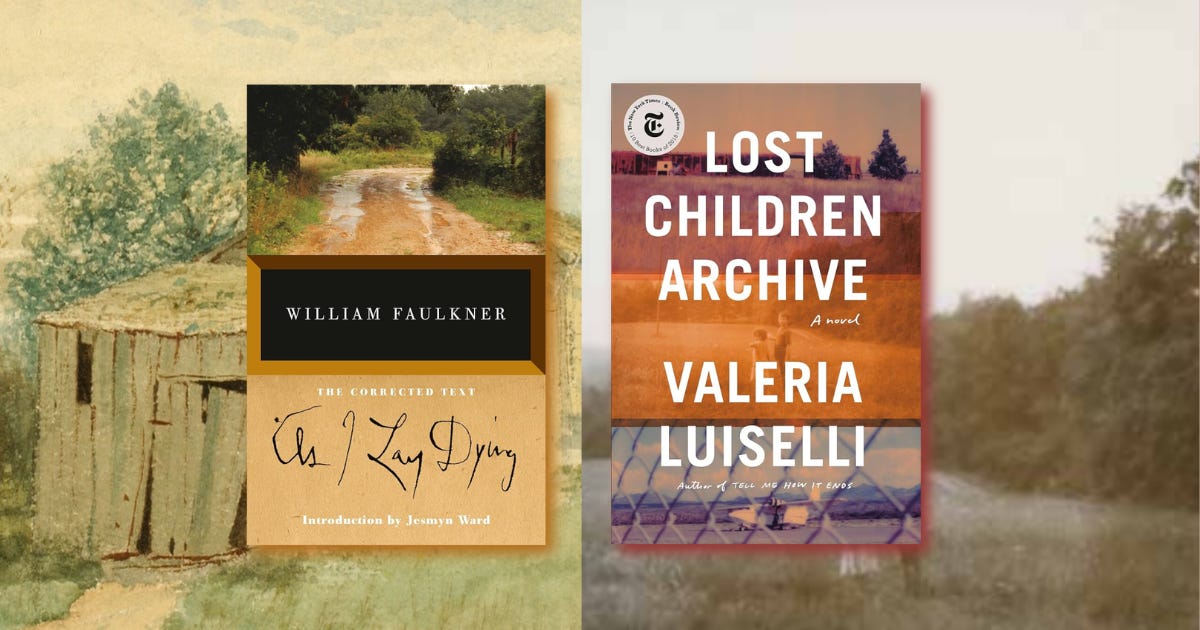
Written almost a century apart, As I Lay Dying by William Faulkner and Lost Children Archive by Valeria Luiselli seem radically different, but similarities do abound. One is a 1930 Southern Gothic novel known for its stream-of-consciousness narrative and fifteen different perspectives. It follows the Bundren Family as they embark on a journey to bury their wife and mother, Addie, all the way in Mississippi. Let’s just say they encounter more than their fair share of obstacles.
The other is a 2019 novel following a family on a road trip from New York to the US-Mexico border, exploring marital troubles and offering a deep look at the migrant crisis, told from the perspectives of the family’s two children.
Beyond the similar story of a road trip, or wagon trip, for the Bundrens, the greatest connection lies in the language used by both writers. Both novels use unusual syntax and organization to add depth. Such deviations from the “norm” are not always received well by readers. Nor do they always have their intended effect. Surprising the reader with a unique form can create an unforgettable reading experience or compel the reader to put the book down. By breaking traditional writing norms, both Faulkner and Luiselli take a risk—with mixed results.
Luiselli’s continuous experiment is with grammar and language. She declines to name any of the characters, perhaps to emphasize the universality of the characters’ experiences. Also absent are dialogue tags (ex. he said, she said), which often leaves the speaker unclear.
Most jarring, however, is the twenty-page (read that again, TWENTY PAGE) sentence in the Echo Canyon section, describing the boy and girl’s arduous journey through the desert. At best, the mental capacity required to endure a twenty-page sentence perhaps embodies their tiresome walk. At worst, it is painfully boring and treads no new territory.
Luiselli also deviates from traditional structure. Instead of being organized into chapters, the text is divided into parts and repeated subheadings like a textbook. They make the book feel, well, like an archive, like the one the characters in the story are actually creating. Some parts are titled “Box,” referencing the boxes the family brings on their trip. The book includes other unusual elements that contribute to the “archive.” The last ten pages consist of Polaroid photos taken by the boy throughout their trip. “Box V” contains a variety of maps, morality reports, and other clippings that the characters acquire during their trip. All these unusual additions try to offer the reader yet another entry point to inhabit the characters’ minds and feel like they are living the story.
Throughout her various methods, Luiselli seeks to ground the reader in the story, not through language or metaphor. Instead, through added elements, she has the reader sort through clippings or read a monumental paragraph to have them physically embody the characters, not just imagine them.
I personally found this very irritating as I read, and wished multiple times that this idea—admittedly very interesting—had been explored in a format more suited to multimedia. Unfortunately, I think Luiselli was fairly unsuccessful in conveying her message through the novel form.
In contrast, Faulkner’s choices, similarly in experimenting through grammar and perspective, were much better executed. He creates distinct voices for each character, using larger words for more educated characters, a looser organization for younger characters, and varying levels of comprehension based on their mental state. Vardaman, the youngest of the family, repeats many eccentric phrases throughout his chapter, like “my mother is a fish,” a sentence that would never appear in the methodical lists of twenty-plus-year-old Cash’s chapters. The language in the perspectives also changes throughout the book. As Darl goes insane, his chapters shift from an almost omniscient narration to a disjointed, confusing one.
Just like Luiselli, Faulkner used vague pronouns in some chapters, making it difficult for the reader to discern the subject. Sometimes, the topic of discussion is only evident later in the chapters, but it is solvable. Here, this choice further reinforces the book’s internal monologue style. Each chapter represents the train of thought through the narrator’s head. Sometimes it is nonlinear or lacks a clear subject, much like how one’s mind functions in reality.
What separates Faulkner from Luiselli is that we know the characters in As I Lay Dying; if we cannot understand a chapter at first glance, we are still, at least, invested in the particular character. In Lost Children Archive, not knowing the characters’ names creates such a distance that when you don’t understand something, it doesn’t seem worth it to figure it out.
Regardless of an author’s intention, success lies in the effectiveness of innovative techniques. It is one thing for an author to attempt novelty, but quite another to succeed. Luiselli’s novel is an example of such a failure. Although well-intentioned, her novel falls short of excellence again and again. The choice to section the novel by topic, using subheadings instead of a traditional chapter format, creates ambiguity for the reader. It is unclear in what direction the novel is intended to travel. Elements of the novel, such as the photos and maps, are a success, reinforcing the idea of the archive. Where the novel falls flat is with Luiselli’s command of language. Her language is plain and harsh, peppered with too many overly detailed descriptions of minutiae.
However, her experimental liberties quickly become too taxing for the reader.
Faulkner’s novel was experimental, not overexerting the reader, merely stretching them to inhabit the characters’ minds more than usual. Although sometimes difficult to interpret, there are many gems to unearth in As I Lay Dying. Faulkner seeks to reveal the Bundren family’s inner thoughts, a motive clear to the reader. Vardaman’s nonsensical chapters are parsed by the reader and rationalized because he is young. The main character of Luiselli’s novel writes in a convoluted way that is incongruent with her identity as an educated, curious person. It is the boy, in fact, who has the most straightforward narrative to follow. Some descriptions in As I Lay Dying are unclear, requiring the reader to think more and re-read.
Writing, like all forms of art, is all about experimentation. Humanity would never have been blessed with great literary works without a drive for experimentation, which must be applauded. However, it is not only about the effort but also about the result. Lost Children Archive attempts to shift the model of a novel, to minimal success, while As I Lay Dying has remained relevant for generations. There is never triumph without failure, though, and through the lessons that Luiselli’s novel provides, society is one step closer to another indelible novel.
Have you read either of these books? What did you think of them? I’d love to hear your thoughts in the comments!